

A version of this essay was published by firstpost.com at https://www.firstpost.com/opinion/from-chanakya-to-ai-india-needs-its-own-management-model-14038647.html/amp
If you interpret the term ‘management’ broadly, that is, to include not only the day to day running of companies, but also the bigger picture of governance, leadership, strategy, geoeconomics, and even civilizational survival, the clear answer is that there indeed is a unique Indian style of management.
Whether it has been uniquely successful in the past is an open question, and given the ravages of invasion, one may be tempted to say it hasn’t been; similarly whether, or how, it is appropriate for today’s and tomorrow’s needs is another good question.
But it is useful to identify what may in fact be the factors underlying such a style of management, and there are likely three reasons: civilizational, cultural, and practical.
Civilizational
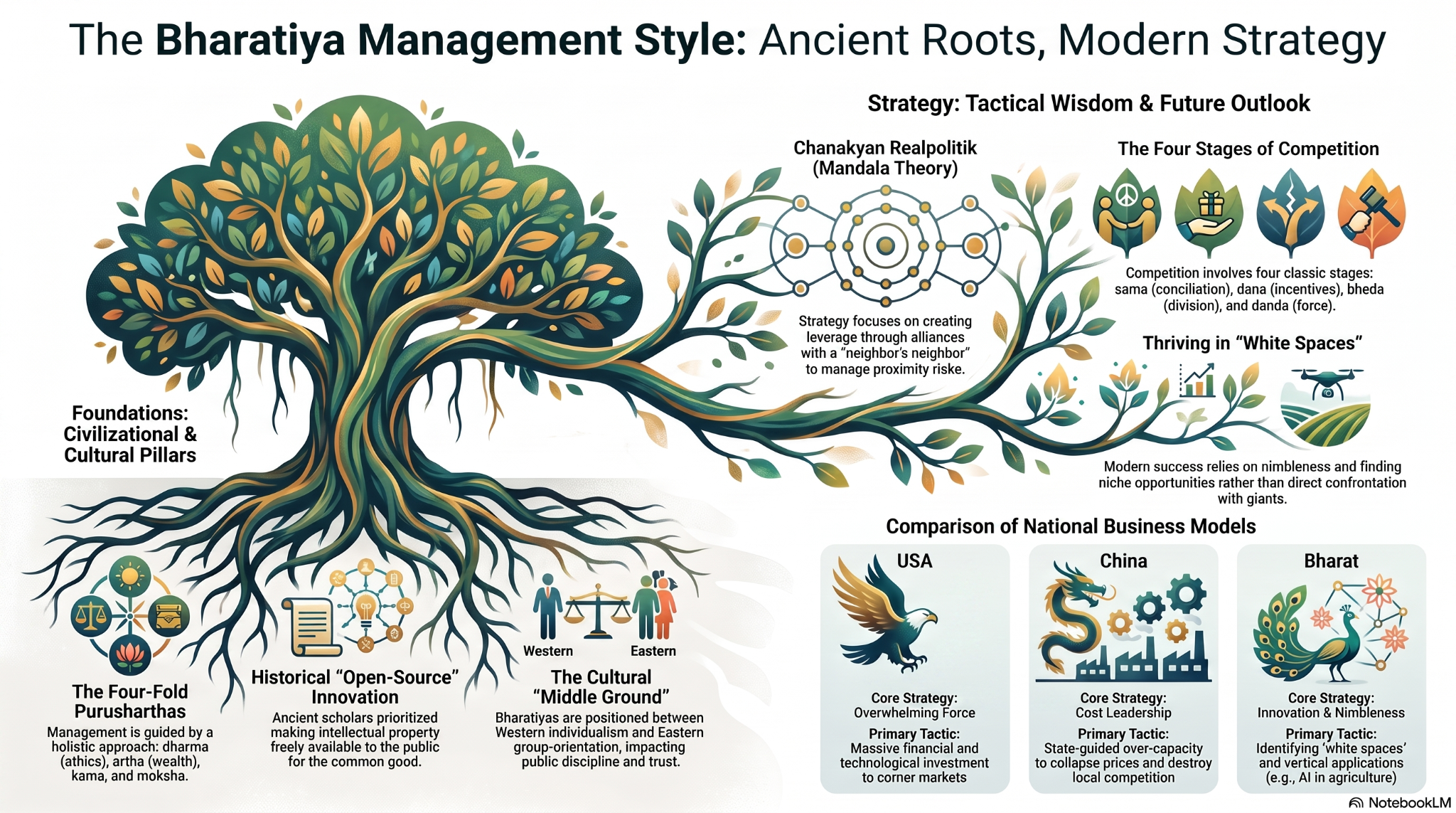
The first is perhaps the idea of Bharatiya exceptionalism: that is to say that Bharat exemplifies a singular civilizational thread that goes back to the ancient four-fold Hindu idea of purusharthas: dharma, artha, kama, and moksha. It is a holistic approach, perhaps most evident in the Bhagavad Gita, with its emphasis on ethical leadership and nishkama karma.
It is certainly influenced by the topography and geography of the land, Jambudvipa, which has natural boundaries marking its extremities: Bharat, the land between the mountains and the sea.
The climate and the rivers and the vegetation reflect a reality of natural abundance: what Rajiv Malhotra referred to when he spoke of the ‘religions of the forest’ versus ‘the religions of the desert’. Bharat, in general, had a tropical cornucopia of food, and perhaps that was reflected early in a certain tolerance for not only for other humans, but also for all life.
It is notable that among all the lands that were populated early, Bharat was the one that retained its megafauna the best. All other human settlements saw the rapid extinction of large animals. Sustainability, a key mantra these days, was built into the Bharatiya outlook all along.
This same generosity was seen in trade patterns in the Indian Ocean as well: from 5,000 years ago, Bharatiya sailors executed cross-oceanic voyages, eastward during the southwest monsoon and vice versa during the northeast monsoon. The trade benefited everybody, as valuable goods were exchanged, in an illustration of the theory of comparative advantage.
The infrastructure for trade was brilliantly executed: not only the building of ocean-going ships that plied the Spice Route, and the ability to defend them from pirates, but also the subtler aspects: the “multi-protocol switch” that allowed trading guilds along the peninsular coasts to facilitate trade between say, Romans, and say, Chinese, who had different languages and currencies. Bharatiya traders smoothed the transactions.
Furthermore, the venture capital and banking services for the trading guilds were provided by Hindu temples.
Pax Indica was benign; for instance, 1,001 years ago Rajendra Chola dispatched a large fleet to open up the Straits of Malacca for trade when the Srivijaya Empire interfered with it. The contrast with the current standoff in the Straits of Hormuz is salutary. Yes, it is necessary to ensure freedom of navigation, and the commons, with deadly force if need be.
There was a very real notion of the ‘common good’. For instance, perhaps the greatest intellectual contribution of Bharat was innovation and the creation of Intellectual Property, and then making it freely available to all: not hoarding it for individual benefit.
The model was that scholars and intellectuals were frugal, that the State (king or temple) provided for their basic needs, and in return, they produced masterworks over which they, unlike patenting in the western sense, did not claim any rights.
Thus you have intellectual giants such as Brahmagupta with his invention of the zero, Panini with his context-free grammar, Madhava with his infinite series for trigonometric functions, and much later Ramanujan who wrote down his extraordinary theorems for all, and JC Bose whose seminal wireless communication discoveries he refused to patent, on principle. In fact, one could argue that the entire idea of “open-source” is a Bharatiya invention.
The natural resources of the Indian subcontinent along with the industriousness of its residents allowed for the creation of tremendous wealth; but in the “Guns vs Butter” dichotomy in economics, Bharat neglected to build the guns; which meant that often invaders with guns were able to capture the butter

.Management theory suggests that there are only three sustainable business strategies for long-term viability: 1) customer intimacy, 2) cost leadership, 3) innovation. Bharat historically chose innovation, and its native genius may result in the flowering of an intellectual revolution as the effects of impoverishment by conquest begin to recede.
Cultural
It is interesting to note that Bharatiyas are different from both Occidentals, (e.g. the Anglosphere) and Orientals (e.g. East Asians) culturally. The stereotypes (with good reason) is that Occidentals are highly individualistic and that Orientals are highly group-oriented. Bharatiyas fall somewhere in between, being fairly individualistic, and gregarious, yet only moderately group-oriented.
This has implications for governance. A highly individualistic society needs powerful laws that control individuals, including their tendencies for mischief. Thus, for example, the US is a highly regulated society, and their police are quite capable of unleashing deadly force. A highly group oriented society like Japan has norms that mean children clean after themselves in schools, and that discipline carries over into adulthood as well.
Bharatiyas are neither; the net result is that there is a distinction between public spaces and private spaces. While people may keep their homes spotlessly clean, they have no problem littering anywhere or throwing trash just over their walls onto the public street. They also have no problem breaking traffic rules. “The tragedy of the commons” is rife.
There is also the cultural memory of shortages and deprivation. Since people have grown up in a shortage economy, there is a tendency to hoard, cut corners, to pay bribes, to find any way of getting a slight advantage over others. Thus the unnecessary pushiness on roads, the inability to queue up anywhere, and especially the unwillingness to let people exit a lift before you enter.
This applies to groups as well, as is seen in the “race to the bottom” in the case of the backward, the most backward, and the extremely backward designations intended for government largesse.
There is also the unfortunate feeling that a contract is just a mere annoyance, not something that is to be followed to the letter. Punctuality is a small indicator of this: Bharatiyas on average feel justified in being late and casually making excuses. In contrast, both Anglosphere people and many East Asians (especially the Japanese) are punctual, and they can be trusted to deliver absolutely whatever they promise, whenever they promise.
Interestingly, Chinese, like Bharatiyas, do not have integrity in terms of keeping promises, which is a problem in doing business with both. In Bharat, there is also extreme reluctance to deliver bad news until the very last minute, for instance the day before something is due to be delivered. This can be very difficult for partners to deal with.
Perhaps all this makes Bharat a low-trust society. As a result of all this, doing business in Bharat takes twice as long, and managers need to have contingency plans, and to do intrusive ongoing audits to ensure that things are on time.
But there are inspiring counter-examples of community action and high trust. One is the re-greening of the Aravallis with the support of the Tarun Bharat Sangh and Rajendra Singh: a few villages built simple check dams based on traditional knowledge, bringing back an extinct river.
Practical
In addition to the refined heights of the civilizational perspective, Bharat also excelled in the theories of tactical management and even realpolitik. Even though there is a tendency in certain circles to lionize Machiavelli, von Clausewitz and Sun Tzu, it is likely that Chanakya outdid all of them in the single-minded pursuit of strategy and governance, and he wrote his masterwork a millennium before them.
Chanakya’s ideas of statecraft are notable for their cold realism. He focuses on the creation of leverage and thus power for the sovereign. Speaking of leverage, or competitive advantage, we have seen how China has turned its control of the rare earths supply chain into a weapon; similarly the US has its technology (the recent denial of Anthropic Mythos to all foreigners) as well as its control of the SWIFT network of financial transactions. These can be coercive.
Another of Chanakya’s supremely rational assumptions is that your neighbor is likely to be your enemy, if not today, maybe tomorrow, simply because of proximity and the resulting irritants. Thus it becomes useful to make common cause with their neighbor.
Taking this one step further, you arrive at the Mandala theory of statecraft: a series of concentric circles (for convenience of depiction), where you cultivate your neighbor’s neighbors, and also the Far Emperor or udasina (indifferent power), a player outside the immediate neighborhood, but powerful, and who can have a significant impact on your local power politics. Clearly Indian foreign policy has looked upon the US as a Far Emperor; similarly Indian firms may look upon Big Tech companies as Far Emperors in their local struggles.
Chanakya does not shy away from the harsh realities of power politics. Matsya nyaya, where big fish eat little fish, is a crystal-clear exposition of the idea that might is right: which we see in contemporary affairs, both business and international relations, on a daily basis. In addition, he recognized that information is the key to advantage (as Big Tech demonstrates today), and as such, he made it a priority to collect data, including through a network of spies. This leads to intrigue, infiltration, and the creation of internal dissent among the enemy.
Chanakya’s four classic stages of competition are notable: sama, dana, bheda and danda. Of these, possibly the one that is most widely practised today is bheda,the exploitation of internal fault lines within the enemy. With the “million mutinies” in India, such as farmer protests, CAA riots, and the recent ‘cockroach’ riots, it is clear that there are “toolkits” in play. There is much information warfare, as seen in relentless bot attacks on Bharatiyas on social media.
In modern management terms, India should learn from the successful business models of the G2 powers. The US as a nation, and its big firms, typically use overwhelming force (financial, technological or military, as the case may be) to overwhelm their foes. The metaphor is American football: massive force is a major factor, though tactical misdirection is also widespread.
China uses a different tactic. It goes for cost leadership by using state-guided industrial policy to build massive over-capacity in selected areas; with fierce internal competition, this leads to plummeting costs. Then by flooding export markets with cheap products, they are able to destroy local players in those markets. A case in point right now is the explosion in cheap generativeAI Large Language Models (LLMs) that are undercutting US firms such as Anthropic and OpenAI.
Thus both powers are using their standard operating procedures in generativeAI: US firms are pouring in hundreds of billions of dollars in an effort to corner the market; Chinese firms (and the state) are collapsing the prices in the market.
What should India’s business model look like in this context? Instead of going head-on against these large economies, India should find ways to thrive around them: for example, look for ‘white spaces’ that are not in their gunsights. But these open areas will change rapidly: an example is IT services, which was an opportunity for 20+ years, but not any more.
In generativeAI, a sound Bharatiya play might be to avoid over-investment in foundational models, use (Chinese) open-source models and modify them, for example with multi-lingual capabilities; invest in other areas of the stack such as in vertical applications, for instance in agriculture, or medicine, or governance, or jurisprudence. Bharat can use ‘distillation’ techniques to reduce the need for data, and also create Small Language Models (SLMs) in narrow domains, e.g. in Indic Knowledge Systems.
There is also the salutary example of the operating system, which is arguably the most important piece of software on any machine, because it controls the entire functioning of the system. But Unix, possibly the most capable operating system ever, was open-sourced as Linux, and is freely available and ubiquitous.
On the other hand, Microsoft realized its OS, Windows, was a tremendous distribution channel for third-party applications, and has made its trillions based on it. This is what Anthropic, OpenAI et al are betting on.
Will the future of LLMs be Unix/Linux (open source) or Windows? Nobody knows at the moment, and therefore it may be best to avoid that battle, and focus on other layers of the stack, such as applications (higher layers) or hardware and GCCs (lower layers).
Nimbleness and innovation are key when you are dancing with elephants. Direct confrontation is a bad idea, as in the metaphor of the tree and the cane from the Mahabharata’s Santi Parva, where Bhishma comments on the dialogue between the Ocean and Ganga. He suggests that as canes bend to the river, but trees do not, it is best to yield tactically to superior force.
Bharat therefore has to evolve a business model of its own that is sustainable in the long run, and based on its own capabilities. At the moment, a good test case is generativeAI. Another is aerospace, where as soon as ISRO began to offer niche markets to the private sector, there has been a virtual explosion in startups doing interesting things.
Conclusion
Tradition and ancient texts give Bharat a set of management practices and principles that may have within them the basis for a unique business model that can outperform the competition, which at the moment consists of American-style private capitalism and Chinese-style state-controlled enterprises.
2300 words, 4 August 2026


