

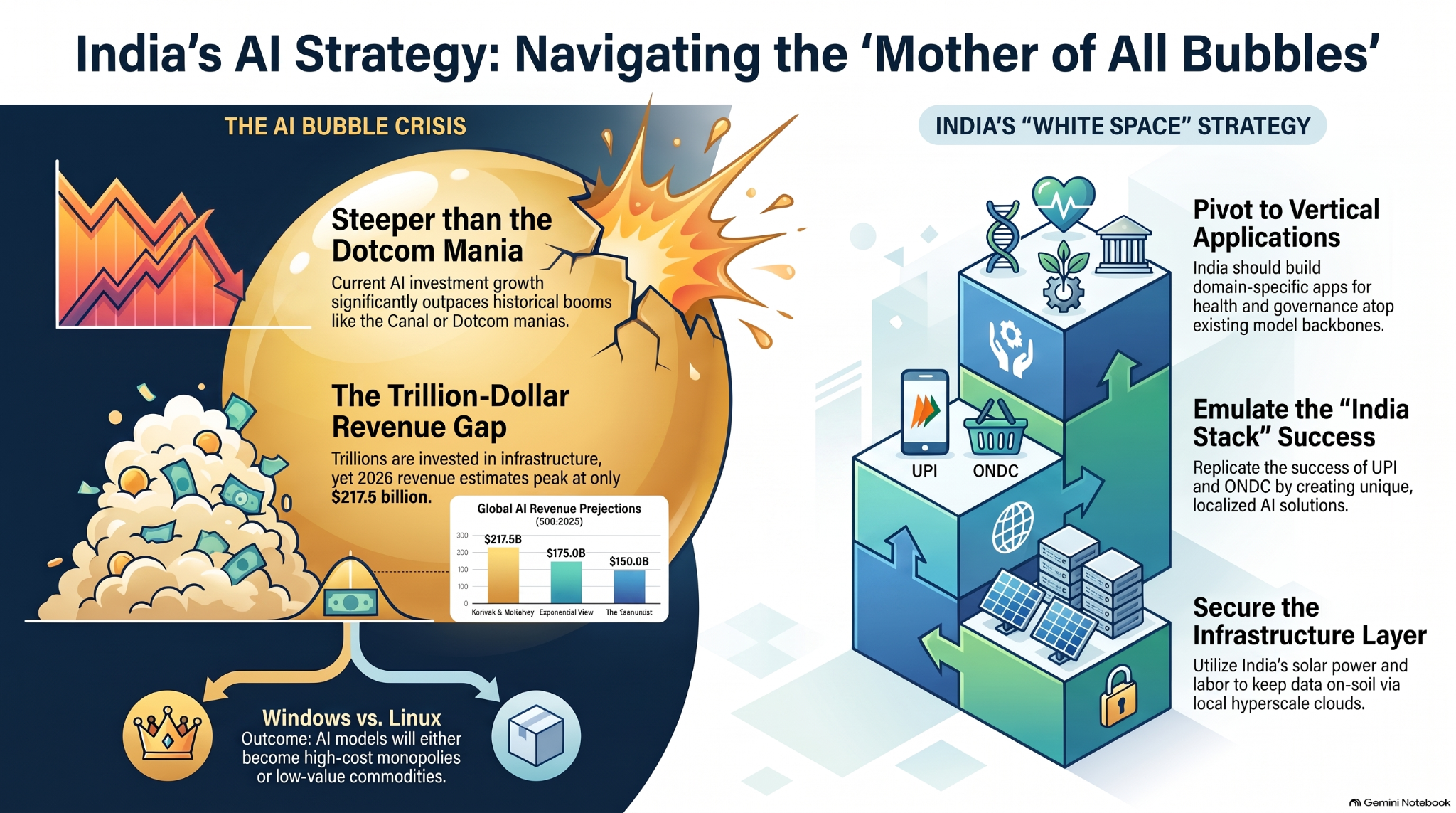
As the greatest investment bubble in economic history in happening right in front of our eyes, with the distinct possibility of a godawful bust in the not too distant future, and persistent memories of promising technologies that crashed and burned, it is necessary, and urgent, to consider how India should play this game of generativeAI now and into the future, whether that future is boom or bust for the technology.
What adds criticality to this matter is the serious but hidden concern about three things: epistemology, values, and national security. The vacuuming up by Big Tech of Indian data gratis (hey, what happened to “data is the new oil”?) as well as the increasingly sophisticated manufacturing of narratives are at least as important as the threat to traditional knowledge systems that India has preserved more or less, under duress, for millennia.
Is there a bubble?
Irrational exuberance almost always ends up in grief, or at least that has been the experience in past cycles. We may be reminded of the Dutch Tulip Mania of 1634, as described in the book Extraordinary Popular Delusions and the Madness of Crowds, wherein tulip bulbs were sold at enormous prices based on speculation about increasing value, which turned out to be baseless.
Those of us with moderately long memories will also remember the 1999-era Internet bubble, where just having a web site and a cool online retail idea was enough to generate speculative investment. The net result was a huge bust, but there was a good outcome: the infrastructure left on the ground by bankrupt investors was useful in other ways in later iterations of the internet, which proved to actually generate value.
But there indeed is irrational exuberance regarding generativeAI. The Wall Street Journal noted that Anthropic seems to believe its Total Addressable Market (TAM) is an eye-watering $30 trillion. For comparison, that was roughly the US’ GDP in 2025. Goldman Sachs goes one step further: it estimated in July 2025 that the global TAM may be as much as $40 trillion.
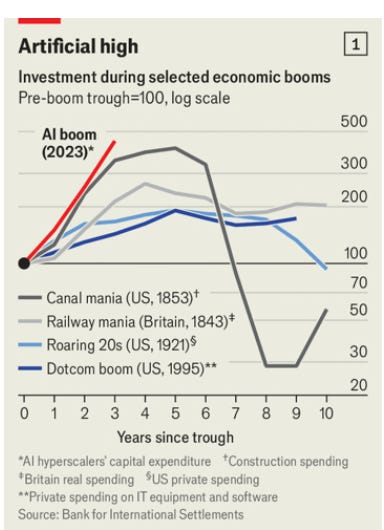
In any case, The Economist magazine estimates that the current generativeAI mania is the daddy of all speculative bubbles in western history, surpassing others in the last few centuries.
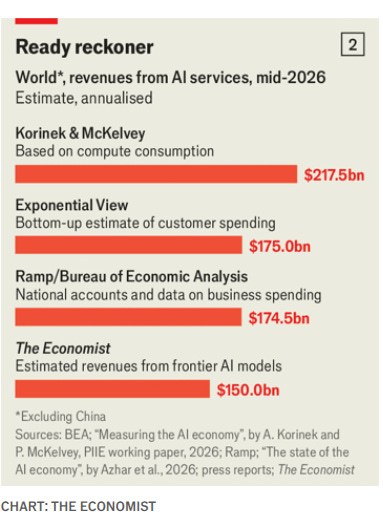
The problem is that there doesn’t appear to be enough revenue and profits being generated to justify the literally trillions of dollars that are being ploughed into capital investment by the likes of Amazon, Google, Microsoft and Meta, i.e. US Big Tech. The Economist magazine, again. Sorry, folks, there does not seem to be a pot of gold at the end of the rainbow.
The bottom line is that at least at the moment, there is a fair chance that there will be the mother of all busts from generativeAI. This is not investment advice, of course, but I’d say caveat emptor.
The two potential business outcomes: the Linux way vs. the Windows way
I am fundamentally an operating systems guy, having spent years working on UNIX internals at Bell Labs. I have observed how that market has evolved over the last forty years, and I believe there are good lessons to be learned from the experience. For, the OS is perhaps the most critical software on any machine, and strangely enough those who focused on it may have made either no money whatsoever, or lots of money.
The “no money” category belongs to UNIX and its descendants, Linux, Android, Apple iOS etc. UNIX was developed at AT&T Bell Labs, and was given away for free to universities and other companies for complicated reasons having to do with AT&T’s status as a regulated monopoly. UNIX is now ubiquitous, running everything from data centers to smartphones to Internet servers through its progeny. Alas, AT&T made absolutely no money from it.
I know this because I moved to Sun Microsystems from Bell Labs, and I was product manager for Sun’s UNIX OS Solaris. If I remember right, I suggested the name ‘Solaris’ in homage to Stanislav Lem. I was active in AT&T and Sun’s attempt to unify the slightly different variants of UNIX (HP-UX, IBM AIX, DEC Ultrix etc.) that had proliferated because experimentation and enhancements on especially the BSD (UC Berkeley) version of UNIX was very easy. We failed in this unification attempt in the “UNIX wars” of the late 1980s/early 1990s.
The result was that UNIX lost a tremendous opportunity to be the desktop/laptop OS, because rival Microsoft was able to do disruptive innovation (see Clayton Christensen, The Innovator’s Dilemma: When New Technologies Cause Great Firms to Fail) and capture the customer base that these firms had earlier served through mainframes, mini-computers and engineering workstations. Before the mid 1990s, Microsoft Windows had relatively little market share.
What is really interesting is that Microsoft then proceeded to “make lots of money”, the second business outcome alluded to above, by realizing that Windows was not just an OS, but a distribution channel for third-party applications. At Sun, I knew this too, but basically as hardware companies, Sun, IBM, etc. didn’t think much of the OS. Apple figured it out, and has made good money off the App Store.
I make a direct analogy between the OS and LLMs. Both are core software in that they both have a clear impact on the hardware requirements, and that they are part of a stack in which many things can be written in layers above. In my opinion, the LLM, just like the OS, could possibly become either background noise (like UNIX/Linux) or the main thing (like Windows).
It appears to me that Anthropic, OpenAI, the hyperscalers et al hope to make their own LLMs the inevitable choice (like Windows), whereas the Chinese are on the way to, intentionally or otherwise, making LLMs immaterial (like UNIX and descendants).
This, incidentally, fits into the standard operating procedures of the respective countries: the US likes to use overwhelming force (the metaphor here is American football), whereas the Chinese use scale, overproduction, and crashing prices to destroy the competition.
From India’s point of view, in either case, this dictates that pursuing foundational models is the wrong game to play. If American Big Tech wins, they become money-minting machines like Microsoft and Windows, and resistance is futile; if Chinese Tech wins, the foundational models become commodities. Therefore, the right place to compete would be on the layers above, that is vertical applications for real problems faced by real people.
India could emulate a major Big Tech company that has taken a similar approach: Apple. Instead of jumping headlong into the LLM race, and spending billions like Alphabet (Google’s parent) and Meta (owner of Facebook and Whatsapp), Apple has preferred to stay on the sidelines, perhaps seeking out market niches or waiting for an LLM winner to emerge. There is a chance that Apple may emerge the victor, intact after the possible bloodbath.
Sovereign AI and dancing with elephants
What, then, does AI sovereignty mean for India? In my humble opinion, India needs to find the “white spaces” that neither G2 giants (i.e. the US and China) are attempting to occupy. Therefore, India should look at areas of the overall stack that are open to it, and which it can profitably involve itself in.
Even though the most obvious thing that comes to mind when you talk about sovereign AI is a Made-in-India foundational model or LLM, that is overkill considering the enormous expense it would entail, literally in the billions of dollars. It’s also something that has been done already by both American and Chinese players, so there’s nothing novel about it.
On the other hand, unique applications that take into account peculiarities in the Indian environment, and provide real value to Indian consumers/businesses may well be of considerable value. Once again, there is an analogy: the India Stack, which has not only provided us with the wildly successful UPI, but also ONDC, and various other applications, such as Account Aggregator, FASTag, UMANG, Government e-Marketplace.
Here we have a stack that is building domain-specific applications atop a standard backbone, e.g., Ayushman Bharat Digital Mission. That is where the value addition for India as a nation may come. One example, already explored by Sarvam AI, is that of multi-lingual capability. This could have a revolutionary impact on mother-tongue education, for instance if school textbooks are seamlessly translated by AI that would likely improve early-education comprehension.
Just as the 10-year-old UPI, imagined for Indian conditions, has revolutionized payments, there surely are applications, most importantly in such areas as public health, jurisprudence, and governance, that will have a massive payback if implemented.
Furthermore, there is the layer below, which is the hardware/computing infrastructure. Even though there are concerns about the availability of power and water, the fact that there is both less expensive skilled labor and increasing amounts of solar power, and the significant amount of opposition to them in developed nations, may well make India attractive to hyperscalars and others. Keeping a lot of Indian data on Indian soil is a good idea, too. Bonus: In case of a bust, all that infra will be available at big discounts.
By the way, here’s a graphic I found on X, from an investor named Himanshu Sinha. He’s a little pessimistic, and his diagram shows the layers in the opposite direction from me, but it captures the entire stack concisely. The question, of course, is how well India can do in the applications layer and the “AI infrastructure” layers according to Sinha.
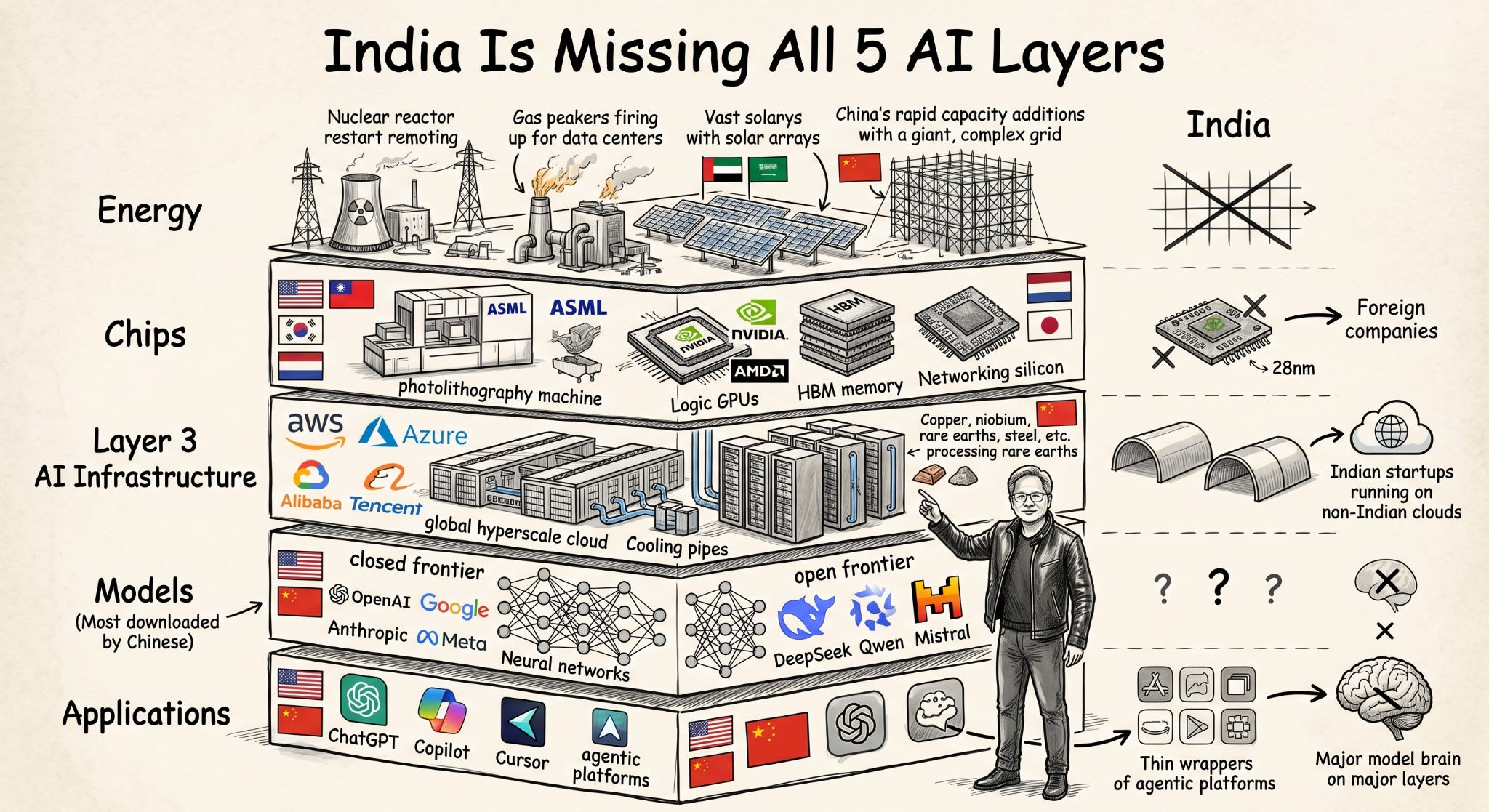
It may be a question of glass half-full, but I believe India can play in the white spaces of applications and infrastructure.
The goodies generativeAI may bring
Every day brings new news about advances based on generativeAI: humanoid robots that can run as fast as Usain Bolt, Andrew Ng’s new plans to build a custom one-on-one tutoring system, and news of agentic AI escaping from its sandbox and roaming about unhindered, as in the case of OpenAI agents’ exploits on HuggingFace. Now comes the ‘proving’ of the Navier-Stokes equation by OpenAI, amidst allegations of IP theft from NYU/Anthropic researchers.
There are clearly things to marvel at, but also to worry about. One of the big concerns is the massive hoovering up of Indian data by Big Tech, with neither compensation nor respect for copyright. This means both large-scale current financial, health and other data, but also the troves of Indian Knowledge Systems that may have precious, untapped knowledge in them.
Big Tech is cavalier about knowledge, treating it as free for it to plunder. There was a recent story about how Anthropic was buying up old and rare books, cutting up their bindings, speed-scanning, and then pulping them. We can expect similar treatment of Indian data.
Similarly, the OpenAI habit of offering its products free to researchers, and then apparently monitoring what they did with them – which is the point of contention between them and Tristan Buckmaster (NYU) and Levent Alpoge (Anthropic) in the Navier-Stokes case – is also an interesting analogy with the classic “first hit for free”. You get my drift.
Wait, there’s more: an allegation of straight IP theft by OpenAI in yet another case. As Goldfinger said memorably, “Twice is a coincidence. Three times is enemy action”.
Then there was Jensen Huang of Nvidia posting that OpenAI has reached Artificial General Intelligence.
We certainly live in interesting times. Too interesting, perhaps. India has a lot to lose if genAI turns out to be the panacea its boosters claim it is, if India is not invested heavily enough. On the other hand, we have seen this movie before: unrestrained cheerleading for new technologies that disappointed (virtual reality, crypto currency etc). India needs to hedge its bets to ensure it can survive whichever version of reality finally materializes.
1970 words, Sept 9, 2026


